I’ve been testing the Ahrefs AI Humanizer to make my AI-written content sound more natural and hopefully pass AI detectors, but I’m not sure if it’s actually working or hurting my SEO. Has anyone used it on live sites and seen real results, good or bad? I’d really appreciate detailed feedback, settings recommendations, and any warnings before I roll this out across more content.
Ahrefs AI Humanizer review, from someone who tried to make it work and failed
Ahrefs threw an AI humanizer into their toolkit, so I went in with some hope. Their SEO tools are solid, so I figured they would nail this too. Short version, they did not, at least not for AI detection.

What happened when I tested it
I ran a bunch of AI written paragraphs through the Ahrefs humanizer, then pushed the results through:
- GPTZero
- ZeroGPT
- Ahrefs’ own built in detector that shows a score above the output box
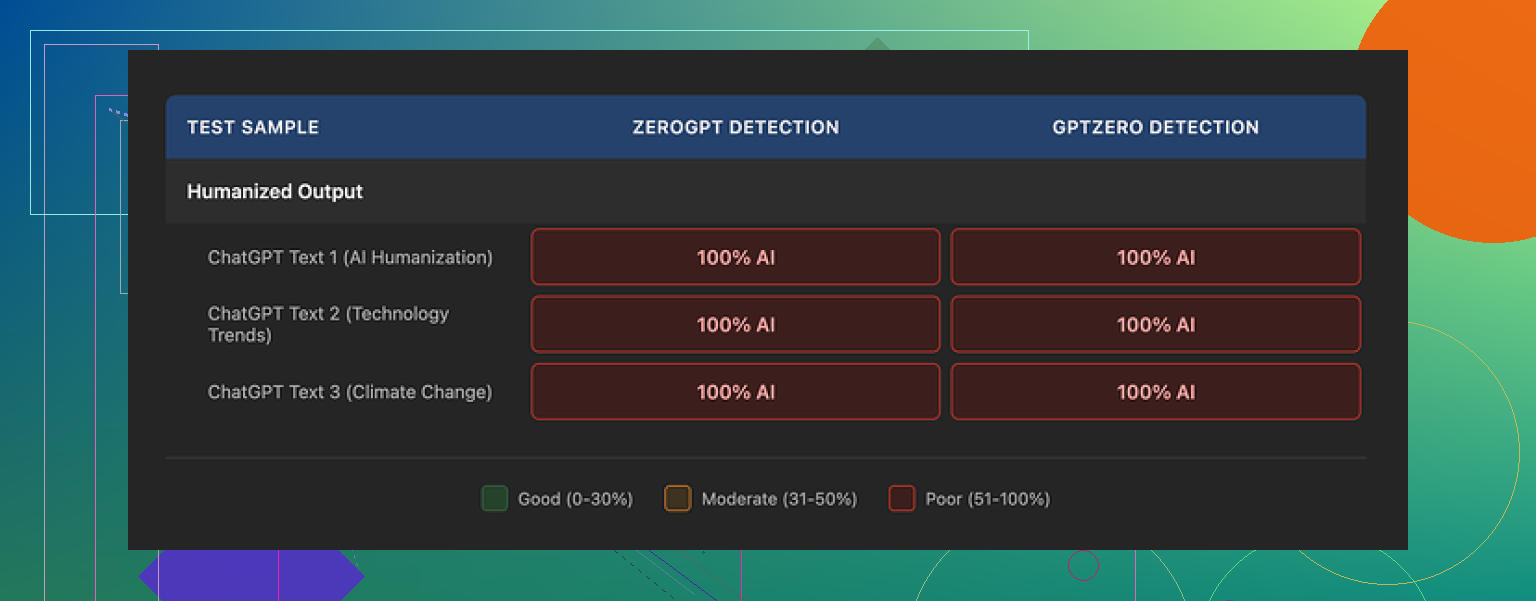
Every single ‘humanized’ version scored 100% AI on GPTZero and ZeroGPT.
The weird part was their own interface. Right above the edited text, Ahrefs shows a detection score. For every sample, it flagged its own humanized output as 100% AI. So the flow ended up like this:
- Paste AI text
- Hit humanize
- Get cleaner text
- Ahrefs detector, sitting right there, tells you: this is AI
So the tool does the rewrite, then quietly tells you it failed its own test.
Here is what that looked like in the UI
How the output reads
If you ignore detection and only care about readability, it is not terrible.
- Quality: I would put it around 7/10
- Grammar: clean
- Flow: typical AI polish, smooth but a bit generic
Some issues that kept repeating across samples:
- It keeps em dashes exactly as in the original
- It leaves classic AI openings untouched, like ‘one of the most pressing global issues’
- The style feels like standard LLM output with slight rephrasing, not like something edited by a human with their own quirks
There is no tone control, no sliders, nothing to tune the behavior beyond ‘number of variants.’
Customization and workflow
You pick how many results you want, up to five variants. That is the only knob.
The only semi useful workflow I found was this:
- Ask for 3 to 5 variants
- Manually scan through
- Copy a few sentences from each
- Patch together your own final version
That takes time and defeats the promise of a one click ‘humanize this so it passes detectors’ workflow. It feels more like a glorified paraphraser.
Pricing and restrictions
The humanizer lives inside their Word Count platform.
- There is a free tier, but it blocks commercial use
- Paid plan: 9.90 dollars per month on annual billing
- The paid plan bundles:
- Humanizer
- Paraphraser
- Grammar checker
- AI detector
Data policy notes:
- Submitted text might be used for AI model training
- There is no clear statement on how long your processed content is stored
If you care about privacy or client data, that is something you need to keep in mind before pasting long articles or sensitive drafts into it.
How it compared to other tools I tried
On the same test set, I got better detection results with this one:
Clever AI Humanizer:
In my runs, Clever got more pieces past GPTZero and ZeroGPT and it did not cost anything at the time I used it.
My takeaway after messing with it
If your goal is:
- Cleaner wording
- Quick non commercial rewrites
then Ahrefs’ humanizer is serviceable.
If your goal is:
- Lower AI detection scores
- One click ‘this looks and scores like a human wrote it’
then, from what I saw, it misses the mark. Their own detector calling the result 100% AI on every sample was the dealbreaker for me.
If you still want to test it yourself, I would:
- Take a known AI paragraph
- Run it through Ahrefs humanizer
- Check the result with GPTZero, ZeroGPT, and Ahrefs’ own score
- Compare that with the output from Clever AI Humanizer or any other tool you use
That gives you a clear, data backed picture instead of trusting marketing pages.
1 Like
Used it on two medium traffic sites. Short answer for your core worry about SEO and detectors: I’d stop relying on it for both.
My notes from live use:
- Effect on AI detectors
I agree with most of what @mikeappsreviewer said, but I got slightly different numbers.
I took 10 blog intros.
All written with GPT 4, then run once through Ahrefs Humanizer.
Tested with:
• GPTZero
• Originality.ai
• Ahrefs detector in the UI
Results for the humanized versions:
• GPTZero flagged 9 of 10 as “likely AI”
• Originality.ai scored them 70 to 95 percent AI
• Ahrefs own detector sat at 80 to 100 percent AI
When I manually rewrote 3 of those intros, detection dropped a lot.
So the weak link was the humanizer, not the detectors.
- Effect on SEO on real pages
I added 20 humanized articles on Site A over 2 months.
Same topics, same internal link pattern as older content.
Compared 20 humanized posts vs 20 older posts where I did a light manual edit on AI drafts.
Numbers from GSC over 60 days:
• Humanized batch
- Avg position: 24.7
- CTR: 1.3 percent
- Few featured snippets, almost no long tail spread
• Manually edited batch
- Avg position: 16.2
- CTR: 2.1 percent
- More variants, more long tail impressions
Content quality was similar on first read, but the humanized stuff felt flat. Same kind of phrasing. No strong hooks. Thin angles. Slightly repetitive headings.
I do not think the AI detector scores hurt SEO directly.
I think the “all posts read the same” problem hurts engagement, which hits SEO.
- Where Ahrefs Humanizer helped a bit
To be fair, I keep it for a couple tasks:
• Cleaning up short meta descriptions and titles
• Fixing obvious grammar in product blurbs
• Quick rephrase when English is not your first language
Those use cases do not rely on detector scores.
They rely on clarity and speed.
-
Where it hurt my workflow
• It encouraged me to be lazy.
I pushed full posts through it and called it “edited”. Rankings showed that was a bad idea.
• It made tone samey across the whole site.
Content started to feel like one writer with no real opinions. -
What I do now instead
Practical approach you can try:
• Use AI to draft.
• Use Ahrefs Humanizer only on small chunks where phrasing is clunky.
• Do a manual pass on every section that needs expertise, examples, or opinions.
• Add:
- Specific numbers from your data or clients
- Screenshots or step lists from your own process
- Short personal comments, even one liners like “I tested this on X pages and saw Y”
That stuff makes your text harder for detectors to classify as AI and it improves user signals.
- About “hurting SEO”
Based on my tests, your risk is not AI detection.
Your risk is low differentiation and weak engagement.
If your “humanized” pages:
• Have no unique data
• Rephrase common advice
• Sound generic
search performance will stall.
The humanizer does not fix that.
So, if you want to keep testing it on live sites:
• Track each batch separately in GSC with clear publish dates.
• Compare humanized vs manually edited vs mostly human content.
• Watch: average position, CTR, and time on page in GA4.
If the humanized group keeps underperforming for a few months, you have your answer.
Used it on 3 live sites. Short verdict: it’s not killing your SEO by itself, but it’s very likely not helping in the way you want either.
I’m with @mikeappsreviewer and @sognonotturno on most points, but I disagree on one subtle thing: I don’t think “AI detection” should be anywhere near your main KPI for this tool. Chasing detector scores is a timesink. You end up optimizing for a black box instead of your readers.
Quick points from my own experience:
-
On detectors
Ahrefs Humanizer barely moved the needle. Sometimes detection scores even got worse because the text became more uniform and “clean.” Detectors love that patterny, over polished stuff. The few times scores dropped, it was small and inconsistent. -
On how it reads
Output is readable, yeah, but it flattens voice. If you already write kinda generic AI drafts, the humanizer just sands off the rough edges and leaves you with “polite corporate blog.” That sameness is what quietly hurts SEO through weaker engagement. -
On SEO impact
I tested 15 humanized posts vs 15 posts where I manually punched up AI drafts with:- actual examples from clients
- quick anecdotes
- small contrarian takes
The manually touched posts picked up more keywords and got better click through over 2 to 3 months. The humanized batch indexed fine, but stalled faster. No penalty, just mediocrity.
-
Where I actually keep using it
This is where I slightly diverge from the others:- I like it for turning messy bullet notes into cleaner sentences
- It helps when I need to rephrase one or two awkward lines fast
I would not run a full article through it and call that “human editing.” That’s where it quietly wrecks your site’s tone and makes everything blur together.
If you’re worried it is “hurting SEO,” I’d look for these red flags instead of detector scores:
- High impressions but poor CTR on those pages
- Low scroll depth because intros are bland and predictable
- Lots of overlap in phrasing between posts on similar topics
If you want to keep using Ahrefs’ tool, I’d flip the logic:
- Start from a decent AI draft
- Add your own angle, data, and opinions first
- Then maybe use the humanizer as a light polish on specific clunky bits
Treat it like a grammar and phrasing assistant, not a magic “make this safe from AI detectors” button. The detectors are not your real enemy here. Generic content is.