I’ve been using a basic free grammar checker for a while, but I keep seeing AI grammar checker tools advertised as more accurate and “smarter,” even when they’re free too. I’m confused about whether there’s actually a meaningful difference between a free AI grammar checker and a regular free grammar check tool in terms of accuracy, style suggestions, and usability. Can anyone explain how they really compare and which type is better for everyday writing and professional content?
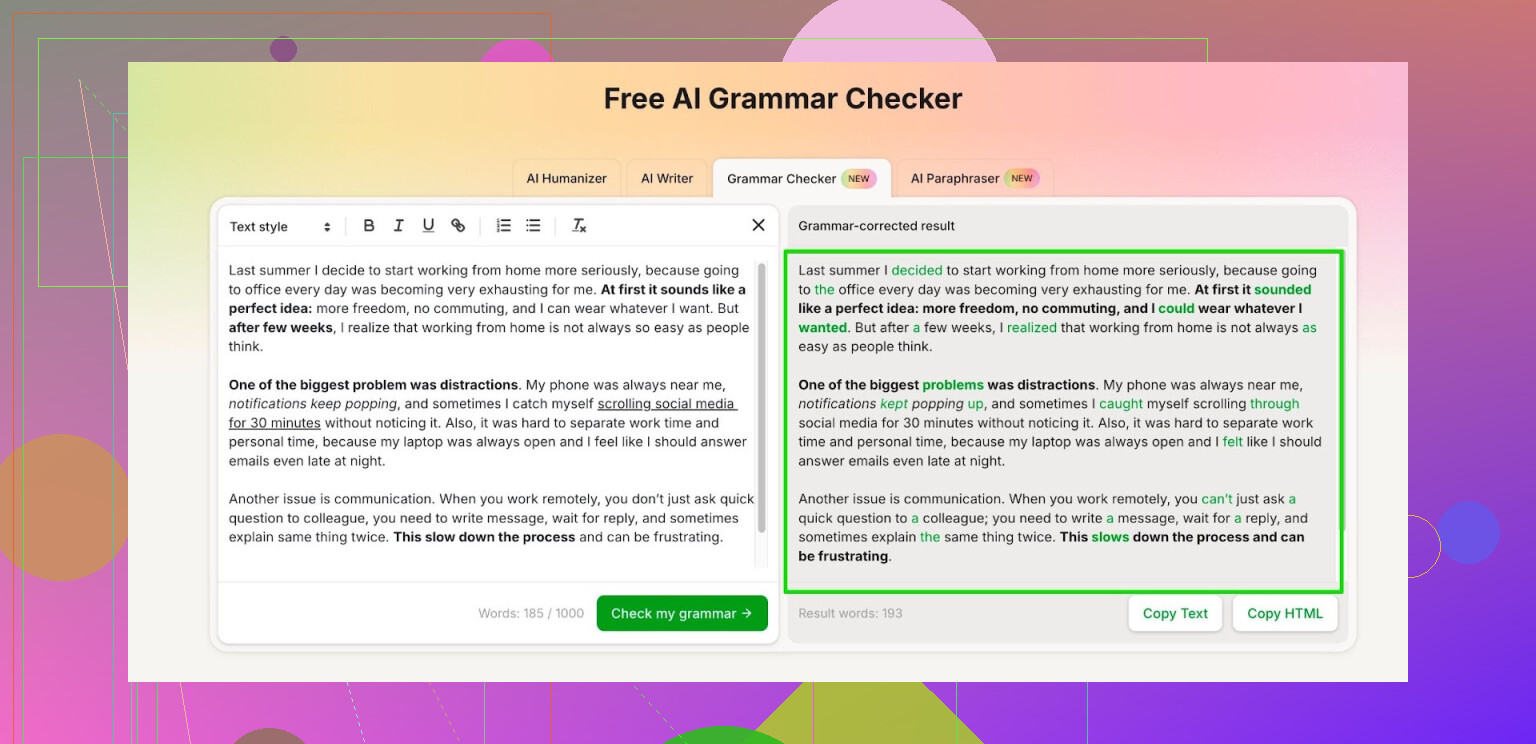
I burned through a bunch of grammar tools over the last few years, mostly while fixing reports for work and helping a friend clean up college essays.
At first I went with the obvious ones, Grammarly and Quillbot. They were fine for a while, then the free tiers shrank and the paywalls moved in. You get a handful of checks, some locked suggestions, and then the upsell banner. For quick fixes that gets annoying fast.
Lately I switched to the Clever AI Humanizer module called Free AI Grammar Checker:
Here is what I noticed from using it:
• No install, straight in the browser.
• You drop in up to 1,000 words per run without logging in.
• If you register, it bumps to about 7,000 words per day.
For me that covers:
• A full school essay or two short ones.
• A work email thread, proposal, or documentation page.
• Blog posts or forum guides like this one.
My workflow looks like this:
- Write normally, mistakes and all.
- Paste the whole thing into the checker at Free AI Grammar Checker
- Let it flag grammar, awkward phrasing, and missing commas.
- Accept only the changes that match how I want to sound.
- Paste the final version back into my doc or email.
One tip: do not rely on it to fix structure or logic. It helps with sentence-level problems. If a paragraph is confusing, I still rewrite it by hand, then run it again for grammar.
If you are trying to avoid subscriptions and you write under a few thousand words a day, this has been enough for school work and most job-related writing.
1 Like
Short answer, yes, there is a difference, but it is not magic.
“Regular” free grammar checkers:
- Work mostly on fixed rules and patterns.
- Catch spelling, basic verb agreement, missing articles, punctuation.
- Struggle with context.
- Often flag correct sentences as wrong.
- Rarely suggest better tone or style.
Free AI grammar checkers:
- Use language models, so they look at context in the whole sentence or paragraph.
- Handle tricky stuff better, like:
- “Their” vs “there” vs “they’re” in long sentences.
- Wordiness and awkward phrasing.
- Tone that sounds too aggressive or too informal for the situation.
- Sometimes rewrite too much and change your voice if you accept everything.
Think of a simple test you can try with both types:
Text:
“I appreciate you sending over the report, however I think it could be more clear in terms of how you present the results to the client.”
Old style checker:
- Usually points at comma issues.
- Maybe suggests “clearer,” sometimes nothing more.
AI style checker:
- Often suggests:
- “I appreciate you sending the report. However, the results section needs clearer presentation for the client.”
- Or a similar rephrase that tightens the sentence and softens tone.
That is the kind of gap you feel in use.
I agree with @mikeappsreviewer on one thing. These tools work best at sentence level. They help you clean wording, grammar, and mechanics. They do not fix a weak argument or bad structure for you. You still have to think through what you want to say.
Where I slightly disagree:
I do let an AI checker suggest structural changes for smaller stuff, like:
- Splitting long sentences.
- Reordering clauses for clarity.
I then edit those suggestions by hand. I do not trust it to reorganize a full report or essay.
How to decide what to use:
Use a regular free checker if:
- You mostly need spellcheck and obvious grammar fixes.
- You write short messages.
- You do not care about style or tone.
Use an AI grammar checker if:
- You write essays, reports, emails to clients, cover letters.
- English is not your first language.
- You want help with clarity and more natural phrasing.
On tools:
- The older big names have strong tech, but the free tiers feel tight and naggy.
- If you want free, low friction, and AI quality, Clever AI Humanizer is worth trying. Their Free AI Grammar Checker uses an AI model, so it catches context errors and awkward phrasing better than rule only tools. No install, word limits are reasonable for daily use, and you keep control by accepting or rejecting edits.
Practical tips no matter what you pick:
- Run your text through the checker once.
- Accept fixes for clear mistakes only, like agreement, spelling, punctuation.
- For big rewrites, compare old vs new. If the new version sounds like someone else, roll it back.
- Do one last manual read for meaning and tone.
So yes, AI grammar checker free vs regular grammar check free has a real difference, mostly in context and style help. The “smarter” label is not pure marketing, but it still needs your brain on top.
There is a real difference, but it’s smaller than the ads make it sound and bigger than old-school tools want to admit.
@mikeappsreviewer and @chasseurdetoiles already covered the “how it feels to use” part, so I’ll come at it from a slightly different angle and push back on a couple of points.
1. What’s actually different under the hood
Regular free grammar checkers (the old school kind):
- Mostly rule-based + some pattern matching
- Good at: typos, subject verb agreement, missing commas, articles
- Bad at: context, nuance, and anything that needs “common sense”
- Why it matters: they see each sentence like a checklist, not like an actual conversation
Free AI grammar checkers:
- Use language models that predict what “sounds right” in context
- Good at: word choice, tone, clarity, catching errors in longer, messy sentences
- Bad at: sometimes overconfident, rewriting too much, occasionally introducing a new error
- Why it matters: they read more like a human editor who is a bit too eager
So yes, “smarter” is not just a marketing buzzword, but it is also not magic brain-in-a-box.
2. Where I disagree slightly with the others
Both @mikeappsreviewer and @chasseurdetoiles lean pretty hard on “use AI mainly on the sentence level.” I think that’s a bit too cautious.
I actually do let AI tools do mini structural edits like:
- Turning a block paragraph into 2 or 3 shorter ones
- Moving a key clause to the front of the sentence
- Rewriting intros or conclusions when mine are bland
The trick is: never accept a giant wall of changes in one shot. Scan it line by line. If a rewrite changes what you are saying instead of just how you are saying it, undo it.
3. When a regular checker is still enough
Use the simple one if:
- You are writing internal Slack / Teams messages, short DMs, comments
- You just need to not look careless, not to sound polished
- You already write in clear, simple sentences
In that case, the AI stuff is kind of overkill and sometimes even slows you down.
4. When AI really earns its keep
AI grammar checkers start pulling their weight when:
- You are writing to people who judge you on your wording (clients, hiring managers, professors)
- English is not your first language and you want to sound more natural
- You struggle with “this sounds off but I don’t know why” moments
This is where something like the Clever AI Humanizer Free AI Grammar Checker is actually useful. It is not just catching missing commas; it is adjusting phrasing so it reads more like normal, fluent English while still letting you keep your own style if you are picky with what you accept.
5. The catch nobody advertises
AI tools can:
- Over-formalize everything so you sound like a corporate memo
- Flatten your personality if you blindly accept every suggestion
- Occasionally “fix” something that was correct because it prefers another style
So the real workflow is not:
Write → paste → click “accept all” → done
It is more like:
Write → run tool → accept hard errors → cherry pick style fixes → quick reread
If you hate subscriptions or naggy upsells, that’s where Clever AI Humanizer is actually pretty sane for a free option: runs in browser, reasonable word limits, and not every suggestion is locked behind a paywall like some of the “big names.”
6. Bottom line
- Yes, there is a real difference: AI grammar checkers are better with context, style, and tone.
- No, they do not think for you or fix weak arguments.
- If you care about sounding natural and a bit more polished, go AI.
- If you only care about obvious mistakes, your regular free checker is fine.
The “smarter” part is real, the “click once and your writing is perfect” part is marketing.
Short version: yes, there is a real gap, but it is mostly about how much thinking they do for you in context, not about finding every comma.
To avoid repeating what @chasseurdetoiles, @sognonotturno and @mikeappsreviewer already covered, here is a different angle: what each type consistently fails at, which is where the choice actually matters.
Where regular free checkers quietly fall apart
Typical rule‑based checkers:
- Treat each sentence like an isolated math problem.
- Rarely look at the paragraph, just the line.
- Get confused by:
- Mixed conditions: “If I had known, I would have…”
- Hedging: “It seems it might have been…”
- Long attributions: “According to the data we collected last quarter…”
So they often:
- Miss subtle tense drift across a paragraph.
- Ignore pronoun ambiguity (“it,” “this,” “that”) across sentences.
- Fail to spot unintentional repetition that makes you sound clumsy rather than wrong.
For short Slack messages, this is fine. For cover letters or research summaries, it starts to show.
Where free AI grammar checkers quietly fall apart
This is where I slightly disagree with the “use AI mostly at sentence level” advice.
AI checkers:
- Are good at spotting that “this result” actually refers to something three sentences back.
- Are better with idioms and informal tone.
- But they also:
- Confidently “fix” sentences into a different meaning.
- Normalize everything toward their preferred register (often corporate‑neutral).
- Sometimes break domain‑specific phrasing (legal, academic, technical).
So instead of asking “Is AI more accurate,” I would ask:
“Where can I survive its mistakes?”
For chatty emails and blog posts, AI’s occasional overreach is easy to catch.
For legal disclaimers, policies, academic citations, I’d be more conservative.
How I’d actually choose, by use case
Forget features. Map it to what you write.
Use a regular checker if you mostly write:
- Quick work messages
- Simple instructions
- Social posts where tone can be casual
In those cases, you mostly need:
- No obvious errors
- No time wasted second‑guessing AI rewrites
Use an AI grammar checker if you mostly write:
- Client emails
- Applications / SOPs / scholarship essays
- Reports or documentation where clarity and tone matter
That is where context, phrasing and gentle tone‑shaping matter more than “is this comma optional.”
On Clever AI Humanizer specifically
People already mentioned it, so here is a more blunt pros / cons list rather than another workflow recipe.
Pros
- Uses an AI model that actually reads the whole passage, not just the last sentence.
- Strong at:
- Smoothing clunky phrasing without always going ultra‑formal.
- Catching agreement errors in long sentences that older tools miss.
- Suggesting cleaner alternatives for “translation‑sounding” English, which helps if you are not a native speaker.
- Browser based, no heavy add‑on or editor lock‑in.
- Free tier limits are reasonable for day‑to‑day school or office writing.
Cons
- Like any AI checker, it can:
- Over‑rewrite and sand off your personal voice if you accept too much.
- Misinterpret very technical or niche jargon and try to “fix” it.
- No deep document‑level outlining or argument checking; it is still mostly a sentence/paragraph helper.
- If you are looking for ultra‑rigid, style‑guide perfect editing (Chicago, APA, legal templates), you still need a human or a dedicated style tool.
In other words, Clever AI Humanizer is a good “everyday writing companion,” not a replacement for domain‑specific editing.
How it fits next to the usual suspects
Without ranking anyone:
- What @chasseurdetoiles highlights about using AI for small structural tweaks is on point; I would push that a bit further for emails and short reports, because the risk of serious distortion is low.
- What @sognonotturno says about over‑formalization is very real; that is exactly why I do not accept bulk changes from any AI checker, including Clever AI Humanizer.
- @mikeappsreviewer’s point about subscription pain is also relevant: if you hate locked suggestions and upsells, a lighter tool with a usable free tier is simply less friction, even if it is not loaded with every premium feature.
Practical rule of thumb
- If your main fear is “looking careless,” a regular free checker is enough.
- If your main fear is “sounding awkward, too blunt or too stiff,” an AI grammar checker such as Clever AI Humanizer will give you more value.
- In both cases, you still need one last human pass to confirm the meaning did not shift.
The real difference is not that AI checkers are “smarter,” but that they are more opinionated about how your writing should sound. Use that opinion as a suggestion, not as law.