I’ve been using StealthWriter AI for rewriting and polishing content, but I can’t afford the paid plans anymore and need something that’s truly free or has a generous free tier. I’m especially looking for tools that keep the same meaning, avoid plagiarism issues, and are safe for long-form blog posts. What no-cost StealthWriter AI alternatives are you using, and how do they compare in quality and reliability?
- Clever AI Humanizer review, from someone who got sick of detectors calling everything “100% AI”
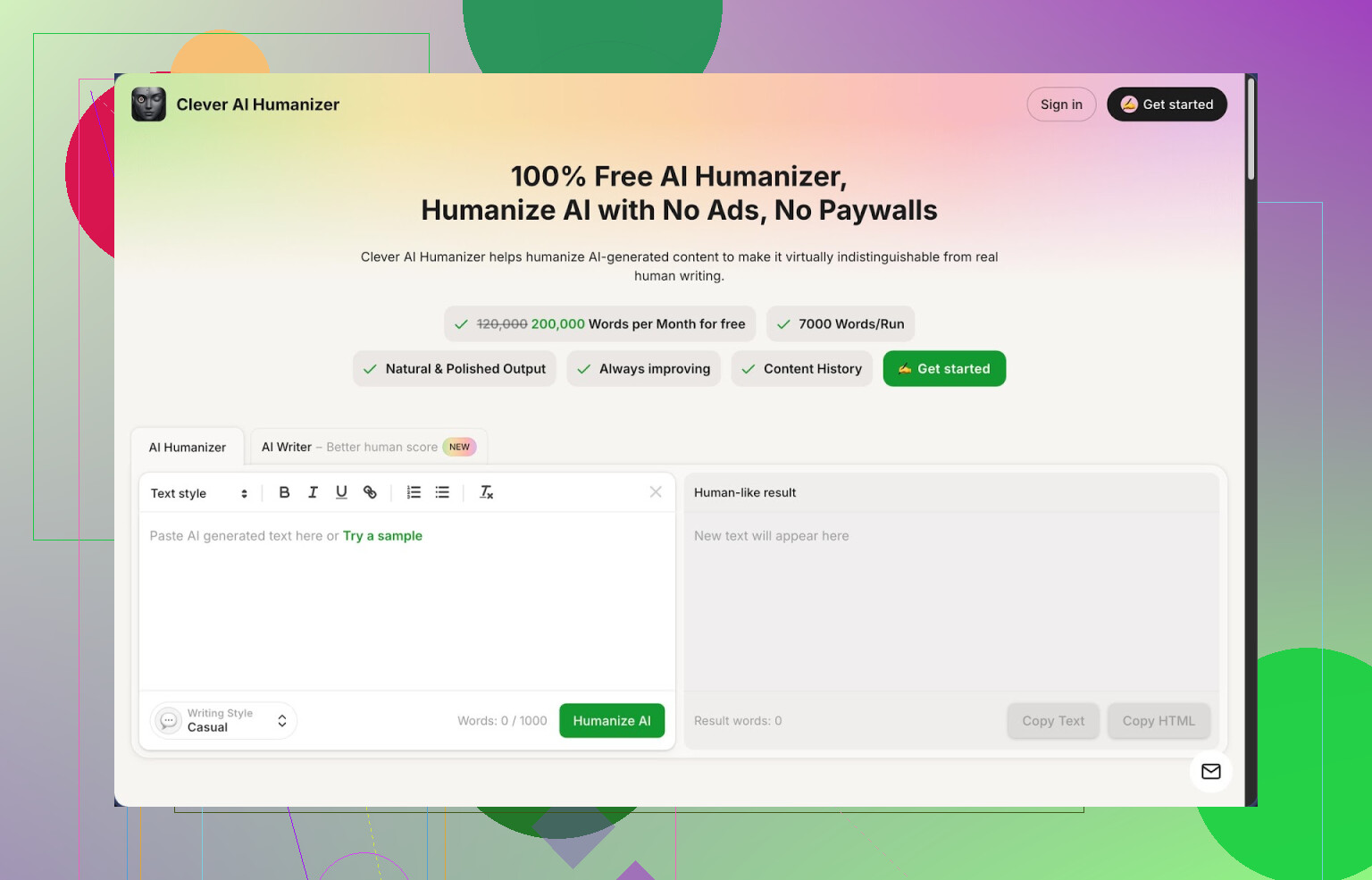
Link: https://cleverhumanizer.ai
I write a lot with AI tools for drafts, notes, and boring stuff like product descriptions. The main headache is always the same: you paste that text into any detector and it screams “AI” in big red letters. ZeroGPT, GPTZero, all of them. After a while it starts to feel pointless.
So I went on a small binge and tested a bunch of “AI humanizer” tools in early 2026, most of which either lock you behind some credit system or wreck the original meaning of your text.
Clever AI Humanizer ended up being the one I kept using.
Here is why, without any fluff.
What you get for free
Clever AI Humanizer gives you:
• About 200,000 words per month
• Around 7,000 words per run
• Three styles: Casual, Simple Academic, Simple Formal
• Built in AI Writer, Grammar Checker, and Paraphraser
No credit system, no paywall popup after three tries. I pushed a lot of content through it during a week and never hit a hard stop.
When I tested it on ZeroGPT using the Casual style, all three long samples came back as 0 percent AI. That result held up several times with different topics like tech explainers and school style essays.
Your mileage will vary with other detectors, but for ZeroGPT it did better than anything else I tried that day.
How the main “humanizer” part works in practice
The main tool is simple.
I did this:
- Took AI output from another model.
- Pasted into Clever AI Humanizer.
- Picked “Casual” for blog type content, “Simple Academic” for school style tasks.
- Hit the button and waited a few seconds.
The output was not word salad. It kept the point of the text, but changed structure, sentence rhythm, and word choice enough that:
• It read more like something I would write on a tired day.
• ZeroGPT started treating it as human.
One thing to be aware of. The humanized version is usually longer. It adds small clarifications and small rephrasings that break up the robotic feel. If you need strict word counts, you will need to trim.
Where it did well
From my tests:
• Long form content, 3,000 to 5,000 words, stayed consistent in tone.
• It did not randomly delete key points.
• It avoided the “AI essay voice” you see everywhere.
Where it slipped a bit:
• Rarely, it introduced one or two generic sentences that sounded like filler.
• You still need to skim the text if the topic is sensitive or technical.
I stopped trusting any humanizer that promises perfect accuracy with no review. This one still needs your eyes on it, but less fixing than most.
Other tools inside Clever AI Humanizer
All of this sits in one interface, no jumping between sites.
Here is what I tried.
-
Free AI Humanizer
The main feature. Paste text, pick style, get a more natural rewrite. Good for essays, LinkedIn posts, product text, and anything that started as pure AI. -
Free AI Writer
You give it a topic, and it writes an article, essay, or blog post.
The better part is you can then humanize that result inside the same flow.
I tested this on a simple essay prompt and got higher human scores than when I wrote in another AI tool and pasted the output afterward. -
Free Grammar Checker
Standard but useful.
It fixed spelling, punctuation, and some clumsy phrasing.
I used it after humanizing longer articles to clean small issues before posting. -
Free AI Paraphraser
This one is handy when:• You have old content you want to refresh.
• You need a different tone for the same idea, for example turning something formal into something simpler.
• You work on SEO pages and need variants that do not look copy pasted.It keeps the meaning close to the original. On technical topics, I did a quick check to make sure it did not distort definitions. Most of the time it stayed accurate.
How I work it into a writing pipeline
What I do now for AI assisted content:
- Draft with an AI writer of choice.
- Paste into Clever AI Humanizer, Casual style for most things.
- If needed, run the result through the Grammar Checker.
- Read once to cut fluff or shorten paragraphs.
- Spot check on a detector if I care about the score for that project.
This is fast enough that it does not kill my workflow, and I stop arguing with detectors as much.
Strengths
• Fully free at the time I tested it, with a big monthly word allowance.
• Simple UI, no clutter.
• Keeps the core idea of your text, instead of spinning a new article that does not match your brief.
• Works well with ZeroGPT based on my own tests.
Weak points and things to watch
It is not magic. Some issues:
• Some detectors will still sometimes mark the result as AI. Different detectors behave differently, and some are overly aggressive.
• Output length usually increases. If you write for strict formats like journals, grant applications, or forms, you will need manual trimming.
• You cannot skip reading your text. It reduces risk but does not remove it.
If you want to see a more structured review with screenshots and test results, someone posted one here:
There is also a YouTube review here:

Reddit threads that talk about AI humanizers in general, including Clever:
Best AI humanizers discussion
https://www.reddit.com/r/DataRecoveryHelp/comments/1oqwdib/best_ai_humanizer/
Broader humanizing AI talk
https://www.reddit.com/r/DataRecoveryHelp/comments/1l7aj60/humanize_ai/
If you write with AI a lot and you are tired of seeing “100% AI” on every detector screenshot people send you, this tool is one of the few I would say is worth testing for yourself, especially because you do not have to pull out a card to get real use out of it.
1 Like
If you are leaving StealthWriter because of price and want something free that still keeps your tone, here are a few options that work well as a stack.
Quick note, I saw what @mikeappsreviewer wrote about Clever Ai Humanizer. I agree it is solid, but I would not rely on it alone for every use case.
-
Clever Ai Humanizer
• Good when you start from AI text and want it to pass basic detectors and sound less “default GPT”.
• The big plus for you is the free quota. Around 200k words per month is a lot if you write daily.
• Use the Casual style for blog posts and Simple Academic for essays.
• I would not use it as your only polishing tool for nuanced topics. Run a quick manual pass after.Workflow idea to replace StealthWriter style polishing:
• Generate or write your draft.
• Run once through Clever Ai Humanizer for “de-AI” tone.
• Then fix structure and clarity in a separate editor. -
QuillBot free tier
• Free plan gives limited characters per run, but for short paragraphs it is fine.
• Strong at sentence-level paraphrasing without changing meaning too much.
• Use it when you need tighter wording than Clever delivers, or when Clever makes things a bit wordy.
• Set it to “Standard” or “Fluency” for safer rewrites. -
Grammarly free
• Not a humanizer, but good for clean up after Clever Ai Humanizer or any other rewriter.
• Use it only for grammar and clarity, ignore style “suggestions” you do not like.
• This replaces the “polishing” part you used StealthWriter for. -
Google Docs + built in suggestions
• Paste your “humanized” text into Docs.
• Use the underlines to catch clunky phrases, repetition, and long sentences.
• This step helps keep your tone because you make the decisions instead of an AI doing a second rewrite. -
Simple free tactic to keep your voice
StealthWriter tries to keep your tone by design. To mimic that with free tools:• Step 1: Write one short “reference” paragraph in your natural style on that topic.
• Step 2: Compare that to the AI output. Look for: sentence length, word choice, how often you use “I” or “we”, and how formal you sound.
• Step 3: After running text through Clever Ai Humanizer, quickly adjust those four things by hand to match your reference.This takes a few minutes per article but keeps the text from drifting into a generic tone.
-
When detectors matter a lot
• Do not run the same text through three different humanizers. That usually increases weird phrasing and risk of errors.
• Use one pass in Clever Ai Humanizer, then light manual editing.
• Shorten repeated sentence patterns like “Additionally, …” “Moreover, …” “On the other hand, …” since detectors flag those patterns often.
If I had to build a free “StealthWriter replacement” stack today for rewriting and polishing that still feels like you, I would do:
Draft > Clever Ai Humanizer > Grammarly free > manual tone tweaks in Google Docs > optional QuillBot for tricky sentences.
This covers humanization, clarity, and your voice with no subscription.
Short version: you can absolutely replace StealthWriter without paying, but it’ll take a combo of tools and a tiny bit more manual work.
I read what @mikeappsreviewer and @viaggiatoresolare wrote, and I mostly agree with them on using Clever Ai Humanizer… but I wouldn’t build my whole stack around detectors like they kinda do. Detectors are super inconsistent and false positives are brutal, so I’d prioritize “sounds like you + is clean” over “0% AI screenshot.”
Here’s a different angle that avoids just repeating their pipeline:
1. Clever Ai Humanizer as the “core,” not the whole solution
If you liked StealthWriter’s “keep my meaning, smooth the edges” vibe, Clever Ai Humanizer is probably the closest no-cost replacement:
- Very generous free tier (people already said ~200k words/month).
- Keeps structure surprisingly well.
- Has different tones, and Casual is pretty solid for web content.
Where I disagree a bit with others:
I would not always paste raw AI output straight in and then trust the humanized result. To keep your voice:
- Write a short intro or outro yourself in your natural style.
- Run only the middle chunks through Clever Ai Humanizer.
- Then stitch everything together and lightly edit transitions.
That keeps you from ending up with that slightly “samey” tone that any humanizer can slip into.
2. Use one more rewriter that isn’t just a humanizer
Instead of only stacking humanizers + Grammarly like others suggested, I’d add a tool that’s good at tightening text, so Clever Ai Humanizer doesn’t bloat your word count.
Two free-ish options that work well with Clever:
-
DeepL Write (free)
Great for:- Shortening sentences
- Making things clearer without turning it into corporate mush
Use case: After Clever Ai Humanizer, paste a paragraph at a time into DeepL Write, pick the option that shortens or clarifies, then accept only the edits you like.
-
Hemingway Editor (web, free)
Not AI, but:- Highlights long or complex sentences
- Flags adverbs and passive voice
This is what actually keeps your stuff punchy and readable, which StealthWriter tried to do for you automatically.
So instead of StealthWriter’s 1-click polish, your new flow is more like:
Humanize with Clever Ai Humanizer → tighten with DeepL Write or Hemingway.
Still free, just 1 more tab.
3. Tone control without another subscription
A trick I haven’t seen mentioned:
- Take one piece of your old writing that you like (pre-AI, or something you know sounds like you).
- Look at:
- Average sentence length
- How often you use “I” or “we”
- How casual your vocab is (“use” vs “utilize”, etc.)
After Clever Ai Humanizer does its thing, quickly scan for:
- Sentences that are way longer than your usual
- Words you would never normally say in real life
- Repeated transitions like “Additionally,” “Moreover,” “In conclusion,”
Edit only those bits. That 5-minute pass keeps your voice intact without needing StealthWriter’s tone sliders.
4. Detectors: use them, but stop worshipping them
Where I slightly push back on both earlier replies: treating ZeroGPT or GPTZero as “truth” is risky.
My suggestion:
- Use one detector only when you must (client, school, platform rules).
- If it flags your Clever Ai Humanizer text:
- Chop long paragraphs into shorter ones.
- Remove repetitive phrasing and generic openers.
- Add 1–2 specific personal details or opinions per section.
That sort of micro-editing often moves the needle more than throwing the text through three different humanizers.
5. Concrete free stack to replace StealthWriter
Without repeating the exact flows already posted, here’s a slightly different “no-cost StealthWriter alternative” setup:
-
Draft
- Either your own writing or whatever AI you already use.
-
Clever Ai Humanizer
- Use it to strip the obvious “AI voice” and keep meaning.
- Apply it in chunks, not on the whole doc at once.
-
DeepL Write or Hemingway Editor
- Tighten, simplify, and get rid of bloated or awkward lines.
-
Light manual pass
- Compare to your old writing.
- Fix only: tone, weird vocabulary, and over-formal transitions.
-
Optional detector check
- Only if required, and don’t obsess if one tool screams “AI” while another doesn’t.
That combo is fully free, keeps your tone way better than humanizer-only workflows, and pretty much covers what people were using StealthWriter for: rewrite + polish without wrecking the meaning.
Short version: you can drop StealthWriter without paying a cent, but you’ll need 2–3 tools plus a tiny bit of manual cleanup.
Where I see things a bit differently from @viaggiatoresolare, @yozora, and @mikeappsreviewer is this: I’d optimize for “consistent personal voice” first, and treat detectors and auto‑polish as secondary. StealthWriter’s main value was tone stability, not magic undetectability.
1. Clever Ai Humanizer in a realistic role
Everyone already covered that Clever Ai Humanizer has a big free allowance and behaves a lot like a StealthWriter-style rewriter, so I will not repeat their workflows. Instead, here is a quick pros / cons snapshot specifically for what you want:
Pros
- Generous free tier so you can rewrite whole articles, not just snippets
- Keeps meaning fairly close, even on long content
- Multiple styles help you get in the ballpark of your tone
- Good at stripping that “default GPT blog post” feel
Cons
- Can inflate word count and add harmless but fluffy filler
- Tone can drift into a “house style” if you run everything through it blindly
- Not ideal for highly technical or legal content without your manual fact check
- Detectors are inconsistent anyway, so you cannot rely on it as a silver bullet
Given that, I would not use Clever Ai Humanizer as a one-click StealthWriter clone that you trust on every paragraph. Use it as a strong first transformer, then re-assert your own voice after.
2. A different stack idea that complements what others said
Instead of repeating their exact pipelines, here is an alternate way to build a no-cost stack around your voice:
-
You write the “voice anchors”
- Draft the intro and conclusion yourself in your natural style.
- Only run the middle sections through Clever Ai Humanizer.
This keeps your personality at the start and end where readers notice it most, while the tool handles the heavy lifting in the bulk.
-
Chunked rewriting instead of whole-doc passes
- Process 2–3 paragraphs at a time in Clever Ai Humanizer.
- After each chunk, quickly adjust 3 things:
- Any word you would never say out loud
- Overly formal transitions like “Furthermore” or “In summary”
- Sentences that feel 30 percent longer than they need to be
This avoids the slightly uniform tone you can get when an entire 2,000-word piece is rewritten in one go.
-
One extra tool for compression instead of more humanizers
Others are leaning on multiple AI rewriters plus Grammarly. I would almost go the opposite direction:- Add one “tightening” tool (like a style checker or editor that highlights wordiness) to fight Clever’s tendency to bloat.
- Manually accept only cuts that do not hurt your tone.
That way you keep the humanized feel but lose the padding.
-
Manual “tone mapping” instead of auto tone sliders
- Grab a favorite piece of your own older writing.
- Compare it side by side with a Clever Ai Humanizer output.
Look specifically at: - Average sentence length
- How often you use first person
- Formal vs everyday vocabulary
Then enforce those patterns in the edited text. This gives you what StealthWriter’s internal tuning tried to do, but with you in charge.
3. Where I partly disagree with the others
- I would not build your whole process around detector screenshots. They are too noisy, and chasing “0 percent AI” can ruin otherwise good, honest writing.
- I also would not chain multiple humanizers. That usually creates unnatural phrasing and makes your tone less consistent, not more.
So:
- Use Clever Ai Humanizer once per passage.
- Use a free grammar checker or style highlighter to clean and tighten.
- Use your own writing as the reference for tone, not a detector result.
This way you still get most of what you liked in StealthWriter:
- Solid rewrite
- Cleaner, smoother text
- Your voice mostly intact
All without paying, and without turning every article into a race to “beat” AI detectors.