I’ve been using Grubby AI to humanize AI-generated text for content and SEO, but the cost is starting to add up and I need to cut expenses. Are there any reliable free substitutes or workflows that can achieve similar human-sounding results without getting flagged by AI detectors? I’d really appreciate recommendations for tools, browser extensions, or specific methods that actually work in real-world blogging or copywriting.
- Clever AI Humanizer, tested on real work
Link: https://cleverhumanizer.ai
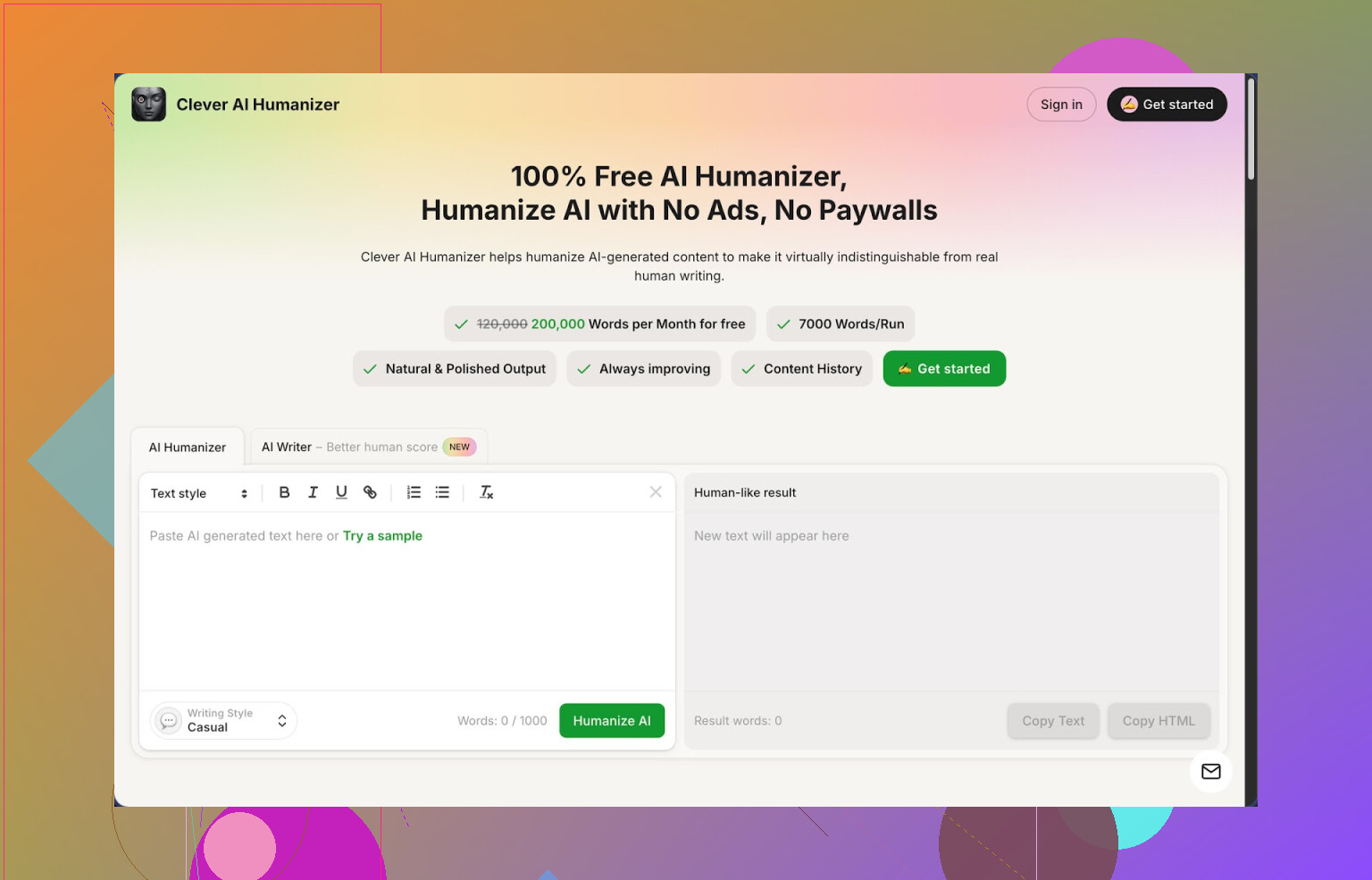
I bumped into Clever AI Humanizer after wasting too much time fighting AI detectors on client stuff. Turned out it was the first tool that did not feel like a trap behind a paywall.
Here is what hit me first:
- Free tier gives about 200,000 words every month
- Up to around 7,000 words in a single run
- Three presets: Casual, Simple Academic, Simple Formal
- Has its own AI writer built in
No account credit anxiety, no trial countdown, it just runs. For longer reports and blog batches, this matters more than people admit.
I ran three different texts through it in Casual style and then checked them on ZeroGPT. All three scored 0 percent AI on that detector. That does not mean it will always bypass every detector on earth, but for ZeroGPT, it passed cleanly in my tests.
How the main humanizer behaves
My normal workflow with it:
- Paste AI output
- Pick Casual if it is content or Simple Academic for reports
- Hit Humanize
- Wait a few seconds
- Copy result and then do a quick manual pass
The tool rewrites the text, breaks the usual AI rhythm, and removes those robotic phrasings you start to see everywhere. It keeps the original message mostly intact. When I compared source and output side by side, structure often changed, but meaning stayed close enough for client use.
It does expand the text sometimes. A 1,000 word draft from another model turned into about 1,250 words after humanization. That made some paragraphs feel more natural, but if you have a hard word limit, you need to trim after.
One thing I liked: it does not wreck the logic of technical explanations. I fed it a piece about API rate limits, and it did not hallucinate anything. It only shifted tone and wording.
Other modules I tried
I did not expect to touch the extra tools much, but some of them ended up in my workflow.
Free AI Writer
You give it a topic and some hints, it spits out an article, then you send that straight into the humanizer. When I did this, detectors showed better human scores compared to taking the same topic from another generic AI, then humanizing. My guess is their writer and humanizer are tuned together.
Used it for:
- Rough blog drafts on low-priority sites
- Support docs that no one reads unless something breaks
- Filler sections for comparison articles
Still needs manual editing, but for grunt work it saves time.
Free Grammar Checker
Feels like a Grammarly-lite. Catches spelling slips, punctuation, and some clumsy sentences. I used it after humanizing when sending stuff to pickier clients. It saved me from some dumb typos on rushed days.
Free AI Paraphraser
This one helped with:
- Rewriting product descriptions so they were not clones
- Changing the tone from stiff to more direct for email sequences
- Adjusting text for SEO variations without spinning nonsense
You paste your text, hit paraphrase, then optionally humanize that again if you want to break patterns further. It did not destroy meaning when I kept sentences short on the input.
How it fits into an actual workflow
After a week of use, my process for AI-assisted writing looked like this:
- Draft in any AI or with their AI Writer
- Run through Humanizer with Casual or Simple Academic
- Run through Grammar Checker for safety
- Manual edit for style and factual checks
Having all four tools in one place speeds things up. No switching tabs between writer, rewriter, grammar app. For bigger content days, that matters.
Good points from real use
- Word limits are generous enough for agency or student workloads
- Casual style sounds close to how many people write online
- Easy to run multiple passes to tweak tone
- No pay pressure in the middle of a task
Stuff that annoyed me
- Some AI detectors still mark the result as AI. Less aggressive scores, but not invisible
- Text sometimes gets longer than needed, so you need to cut it down
- Output occasionally repeats ideas in different words, so skim for redundancy
- Styles are a bit limited, would like more nuanced tones
If you expect 100 percent safety from every detector, you will be disappointed. You still need your own edits and some risk tolerance.
Where to read more or watch tests
More detailed Clever AI Humanizer review with screenshots and AI detection proofs:
YouTube review of Clever AI Humanizer:
Reddit thread comparing AI humanizers:
https://www.reddit.com/r/DataRecoveryHelp/comments/1oqwdib/best_ai_humanizer/
Reddit thread discussing methods to humanize AI output:
https://www.reddit.com/r/DataRecoveryHelp/comments/1l7aj60/humanize_ai/
1 Like
I was in the same boat with Grubby. Got too expensive fast for content scale.
Since @mikeappsreviewer already covered Clever Ai Humanizer in detail, I will skip repeating their workflow, but I agree it is solid as a main free tool. I use it as the last step, not the first.
Here is a setup that keeps costs at zero or close to it:
- Use any free LLM for the draft
OpenAI free tier, Gemini free, or Poe’s free bots. Tell it upfront:
- Target audience
- Reading level (e.g. grade 8)
- Word range
- “Avoid generic phrases like ‘in today’s world’ and ‘ever-evolving’”
Cleaner input means less work for the humanizer.
- Break the AI “pattern” yourself in 5 minutes
Before tools, do a quick manual pass on each post:
- Change opening sentence to something specific and short
- Merge or split a few paragraphs
- Add one or two personal lines like “I tried X on a client site and…”
- Swap common words: “leverage” → “use”, “crucial” → “important”
This already drops AI detector scores a lot.
- Run through a humanizer rotation
To avoid one-tool fingerprint, I rotate like this for bigger batches:
- Pass 1: Light edit in a normal editor, remove repetition
- Pass 2: Free humanizer (Clever Ai Humanizer, Casual)
- Pass 3: If needed, another free rewriter like QuillBot free tier for a few tricky paragraphs only, not the whole article
I do not agree with relying on a single humanizer for every word on a site. Detectors adapt. Mixing tools and manual tweaks keeps the pattern less obvious.
- Style and grammar pass with free tools
- LanguageTool free or Grammarly free for errors
- Hemingway or similar for sentence length and readability
Goal is to land around grade 6 to 8 for most blog content.
- SEO specific tweaks
Do these after humanization.
- Manually place exact match keywords in H2s and first 100 words
- Use LSIs or variations from something like LowFruits or Google autosuggest
- Add one or two internal links by hand
Detectors do not care about this. Search engines do.
- Spot check with more than one detector
ZeroGPT is fine, but I never trust a single detector. I rotate:
- ZeroGPT
- GPTZero
- Writer.com’s detector
If two or three say “likely human” or mixed, I ship it. If they scream “AI,” I rework intro and conclusion, those trip detectors a lot.
Simple workflow example for a 1500 word article:
- 5 min prompt and draft in free LLM
- 5 min manual pattern break
- 1 min in Clever Ai Humanizer
- 3 min grammar + readability
- 3 min SEO edits and links
So about 15 minutes per post once you get used to it.
Big thing for cost control. Keep Grubby or any paid tool only for high risk pieces, like money pages or client work in touchy niches. Use Clever Ai Humanizer and the manual workflow above for supporting articles, listicles, and informational posts.
Grubby got me too. Feels cheap at first, then you look at the invoice and start questioning life choices.
I’ll skip rehashing what @mikeappsreviewer and @shizuka already walked through and add a slightly different angle + a few spots where I don’t fully agree with them.
1. Yes, Clever Ai Humanizer is solid, but use it surgically
I do like Clever Ai Humanizer as a Grubby alternative, especially with that big free word quota. Where I differ a bit from the “run everything through it” approach:
- I only use it on:
- Intro
- Conclusion
- Any section that sounds very “template AI” (lists, how‑to steps, etc.)
- Middle body paragraphs I often keep closer to the original, with just a light manual clean‑up. That keeps the text from turning into over‑processed mush and saves time.
Running entire 2–3k posts through heavy rewriting tools repeatedly can flatten voice and make everything sound like “generic internet human.” Grubby does this too, to be fair.
2. Don’t obsess over ‘0% AI’ scores
This is where I disagree a bit with the multi‑detector chasing. I used to do that rotation and it turned into a time sink.
What I do now:
- Pick one detector you tolerate (ZeroGPT or GPTZero or whatever)
- Check:
- Intro
- One random mid paragraph
- Outro
- If those are in the “mixed / likely human” range, I stop. I do not care if another tool freaks out.
Detectors are wildly inconsistent and none of them are gospel. Over‑optimizing for them can quietly wreck your actual SEO and readability.
3. Free workflow that keeps it lean
Here’s what’s been stable for me on a budget:
-
Draft in any free LLM
Give it:- Clear outline
- Examples of the tone you want (paste a short sample of your own writing)
- Specific banned phrases, like:
- “in today’s digital age”
- “ever‑evolving landscape”
- “it is important to note that”
-
Inject real “you” early
Before tools:- Replace the first 2–3 sentences with:
- A quick opinion
- A concrete example
- A number or specific result
Ex: “I burned $300 on Grubby in 6 weeks before switching.”
AI never writes that naturally unless you force it.
- Replace the first 2–3 sentences with:
-
Targeted use of Clever Ai Humanizer
- Run only the “AI‑sounding” chunks through Clever Ai Humanizer
- Use Casual for content pieces
- Paste back into your doc and trim anything that feels bloated or too “essay‑ish”
I don’t bother with multiple passes or chaining it with other free rewriters for whole articles. That’s where things start to get fuzzy and repetitive.
-
Quick manual “de‑AI” checklist
Scan the post and fix:- Repeated sentence starters like “Additionally,” “Moreover,” “In conclusion”
- Overused words: “crucial,” “leverage,” “robust,” “not only… but also”
- Bone‑dry headings. Change “Benefits of X” to “Why X Actually Helps” or similar.
-
Fast polish, no overkill
- Run the final text through a free grammar checker like LanguageTool or Grammarly free
- Don’t let it rewrite everything, just fix clear mistakes
Over‑accepting its suggestions brings the “AI feel” right back.
4. Where Grubby still makes sense
I actually keep Grubby around, but not as default:
- Only for:
- High‑stakes pages (sales pages, legal‑ish stuff, client money pages)
- Text that must be squeaky clean and on‑brand
- For supporting content, listicles, FAQ posts etc., Clever Ai Humanizer + manual tweaks are more than enough and cost basically zero.
5. Biggest cost saver nobody likes to hear
Train one free LLM to imitate your style. Feed it 3–5 samples of your existing posts and say:
“Mimic this writing style. Short sentences, occasional first‑person, light sarcasm, no corporate buzzwords.”
Once it starts sounding like you, humanizers become a last resort instead of a crutch. That alone cut my tool usage in half.
TL;DR:
- Clever Ai Humanizer is a legit free substitute for Grubby if you use it on the “suspicious” parts only, not the whole internet.
- Stop chasing perfect detector scores, aim for “good enough + readable.”
- Combine one humanizer, one detector, one free grammar tool, plus some honest manual editing and you’ll slash costs without tanking quality.
Skipping what’s already been said by @shizuka, @espritlibre and @mikeappsreviewer, here’s a different angle: focus less on “humanizer hopping” and more on building a repeatable, low-friction system.
1. Use one main humanizer as your “finisher”
If you want a free replacement for Grubby, using Clever Ai Humanizer as your primary finisher is realistic:
Pros of Clever Ai Humanizer
- Generous free word allowance so it actually works at content scale
- Handles longer chunks in one pass, which is useful for full sections or whole posts
- Casual mode is decent for web content and usually breaks the “GPT essay” cadence
- Built-in tools (writer, paraphraser, grammar checker) keep you mostly in one place
Cons of Clever Ai Humanizer
- It can inflate word count and introduce mild waffle that you then have to trim
- Sometimes smooths everything into a slightly bland, generic voice if you use it on the entire article
- Detectors are not guaranteed to be happy, especially if you blindly accept the output
- Limited tone presets, so you still need to manually push it toward your actual brand voice
Where I slightly disagree with others: I would not chain multiple heavy rewriters on full posts. That often creates more artifacts than it removes. Instead:
- Draft with any free LLM
- Do a brisk manual pass to inject your voice
- Run only the most robotic sections through Clever Ai Humanizer
- Manually re-tighten and re-personalize those parts
So Clever Ai Humanizer becomes a scalpel, not a blender.
2. Build a reusable “voice filter” instead of chasing detectors
Rather than relying on detectors as the main success metric, build a short checklist you apply to everything:
- Each article needs at least 3 specific, non-generic details: a number, a niche example, or a quick anecdote
- Ban a personal list of “AI tells” like “in today’s world” or “it’s important to note that” and search/replace them every time
- Force variety in structure: a single-sentence paragraph here, a short list there, then a normal paragraph
That does more for long-term safety than rotating five tools.
3. Use competitors as “spot tools” only
The ideas from @shizuka focus on multi-step rotations and detector checks, which can work but can turn into overhead if you publish at volume.
The angle from @espritlibre leans on manual de-templating that I think is underrated, especially for intros.
And @mikeappsreviewer drilled into Clever Ai Humanizer already, but you do not need to follow their full chain of tools to get value.
Combine the best bits:
- One main free humanizer (Clever Ai Humanizer)
- One grammar checker
- One detector for sanity checks on intro and outro
- Your own style checklist
That is lean enough to keep costs at basically zero, while still letting you reserve any paid option like Grubby only for revenue-critical content.