I’ve been considering using StealthWriter AI to help with my writing, but I’m unsure if it’s actually worth it or safe to rely on. I’ve seen mixed opinions online and I don’t want to waste time or risk low‑quality content. Can anyone who has used StealthWriter AI share a detailed review, including pros, cons, pricing value, and how it compares to other AI writing tools?
StealthWriter AI Review, from someone who spent too long testing it

Link to the tool:
https://cleverhumanizer.ai/community/t/stealthwriter-ai-review-with-ai-detection-proof/23
What I paid and what you get
I went through two of their paid tiers, one at 20 bucks and one closer to 50 per month. Pricing shifts by plan, but that is roughly the range.
Main features I used:
- Two engines: Ghost Mini and Ghost Pro
- Intensity slider from 1 to 10
- Several style presets
- Free plan with 10 runs per day, up to 1,000 words per run, but Ghost Pro is paywalled
On paper it looks solid. In practice, it felt half baked for detection.
How it did against detectors
I ran all tests on the same base texts: academic style, blog style, and a technical explainer. No fluff. No SEO garbage.
Detectors used:
- ZeroGPT
- GPTZero
Results:
ZeroGPT
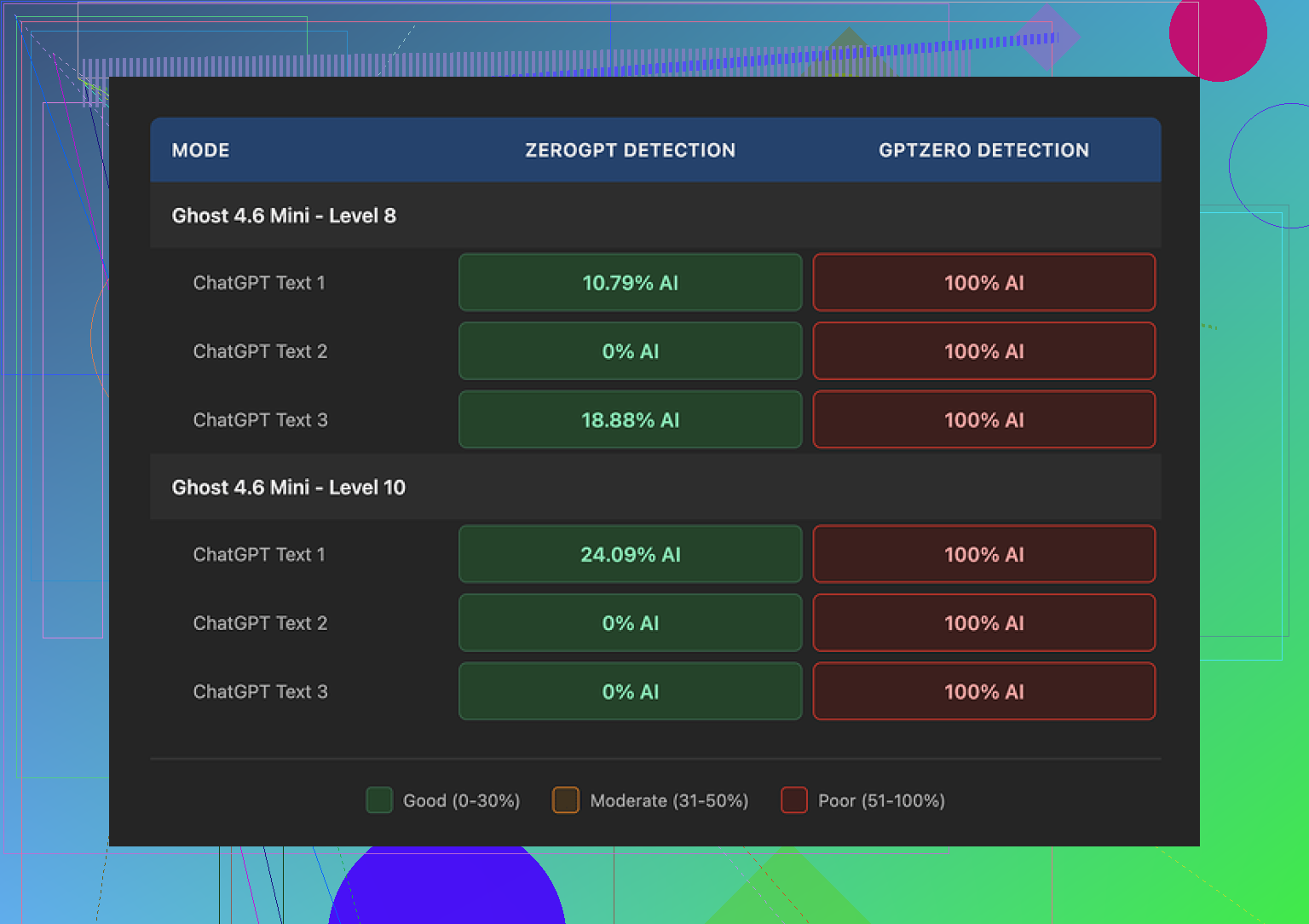
At intensity level 8:
- Some outputs showed 0 percent AI
- Others hovered around 10.79 percent AI
So, for ZeroGPT, level 8 looked okay. Not perfect, but decent enough to be “plausibly human” on that detector.
GPTZero
This is where it fell apart.
Every single run, regardless of:
- Ghost Mini vs Ghost Pro
- Intensity 3, 5, 8, 10
- Different style presets
GPTZero flagged the full text as 100 percent AI every time.
No borderline calls. No mixed scores. Just hard 100 percent AI across the board.
Quality of the writing
I stopped trusting it as soon as I started reading the outputs carefully.
At intensity 8:
- I would rate the writing 7 out of 10
- Most sentences looked usable
- Some odd phrasing here and there
- Occasional missing words that made a line feel off, like “This increase risk flooding” type stuff
At intensity 10:
- Text dropped to about 6.5 out of 10
- I started seeing weird inserts that did not belong
Examples from a climate science piece:
- It randomly added “god knows” inside an otherwise formal paragraph
- It produced “Coastlines areas” instead of “coastal areas” or “coastline areas”
- It wrote “feeling quite more frequent flooding” which sounds wrong in every dialect I know
It felt like the higher intensity pushed it to over-edit in order to dodge detectors, but the result read less human, not more.
One thing it does better than many others
There is one area where it did not annoy me.
Most humanizers I tested inflate the text a lot. Some added 40 to 50 percent more words, turning a sharp 800 word piece into a bloated 1,200 word mess.
StealthWriter usually kept the length close to the original. Same structure, similar paragraph count, roughly the same word count. That helped when I needed to keep formatting, headings, and layout intact.
So if you care about preserving length and structure, it does that part well enough.
Free tier vs paid
Free tier:
- 10 “humanizations” per day
- Up to 1,000 words per run
- Requires an account
- Ghost Pro not available
Paid:
- Unlocks Ghost Pro
- Higher limits
The issue for me was not access. The issue was detection performance. Paying did not fix GPTZero results. Ghost Pro did not change the 100 percent AI flags in my tests.
Comparison with Clever AI Humanizer
I tested StealthWriter side by side with Clever AI Humanizer on the same texts.
My notes:
- Clever outputs sounded more like something I would personally write on a rushed but normal day
- Fewer strange phrases
- Better sentence flow
- No random “god knows” showing up inside scientific writing
Detection wise, Clever AI Humanizer did at least as well as StealthWriter for me, sometimes better, and it is free.
You can check it here:
https://cleverhumanizer.ai/community/t/stealthwriter-ai-review-with-ai-detection-proof/23
When StealthWriter might still be useful
If your priorities look like this:
- Need to keep roughly the same text length
- Want multiple style presets to experiment with tone
- Care more about ZeroGPT than GPTZero
Then you might get some use from it, especially at intensity 6 to 8 where quality is less broken.
If your goal is:
- Passing GPTZero
- Keeping clean grammar in formal topics like science or academic writing
- Avoiding obvious odd phrases
Then from my experience, it does not deliver for the price.
If you want to try something, I would:
- Start with the free tier.
- Use intensity 6 to 8.
- Run your own text through both ZeroGPT and GPTZero.
- Read the output out loud. Anything that makes you pause or laugh, rewrite by hand.
That is what I ended up doing, then I switched to Clever AI Humanizer because it behaved better for my use case and did not cost anything.
1 Like
I’ve been looking at StealthWriter AI for my own stuff too, so here is the blunt version.
Short SEO friendly summary of what you asked:
You want to know if StealthWriter AI is worth your money, safe to rely on for writing, and good enough to avoid low quality content and AI detectors. You have seen mixed reviews and do not want to waste time or hurt your content quality.
My take after testing tools in the same niche and reading what @mikeappsreviewer shared:
- Detection and safety
If you need content to pass stronger detectors like GPTZero, StealthWriter looks weak.
ZeroGPT results can look ok at certain settings, but that is only one detector.
You should not trust any tool that fails hard on one major detector if your goal is “this looks human to institutions or clients”.
I disagree a bit with Mike on one thing. I would not focus much on specific detectors at all. Detectors change. Policies change. If your job, grades, or account depend on this, relying on a humanizer as the main shield is risky.
-
Writing quality
At medium settings, output is usable, but you still need to edit.
At higher intensity, text gets weird. Strange phrases, small grammar slips, awkward tone shifts. That kills trust for readers faster than an AI flag in many cases.
So if you want set and forget output, StealthWriter is not it. -
Structure and length
I agree with Mike here. Keeping similar length and layout is one of its few strong sides.
For things like emails, formatted docs, or posts with fixed layout, that helps.
But you still need to read through everything for odd wording. -
Time vs money
If you plan to pay 20 to 50 per month, ask yourself this:
Are you editing every output anyway.
If yes, you pay for something you then repair by hand. That is not efficient. -
Alternative that makes more sense
If you want an AI humanizer that feels more natural and still handles detectors decently, I would look at Clever Ai Humanizer.
It tends to keep flow more natural, with fewer random phrases in formal topics.
You can try it here:
smarten up your AI text safely
Use it, then run your own tests with detectors and manual review.
Do a small sample, like 3 to 5 articles or essays, before you commit to any paid plan anywhere.
- Practical way to test before you commit
Skip long subscriptions.
Use:
• Free tier of StealthWriter first
• Run the same text through StealthWriter and Clever Ai Humanizer
• Check both with at least two detectors
• Read both versions out loud and mark every phrase you would not say
Whichever version needs less fixing is the one you should keep.
If you want a simple rule for StealthWriter:
Use it only if you care about keeping length and layout, you are fine doing manual cleanup, and you are not depending on GPTZero passing.
For anything high stakes, I would avoid relying on it as your main tool.
StealthWriter AI is basically fine if your standards are “meh, close enough,” but it’s not something I’d trust for anything that actually matters.
Quick hits from my side, trying not to just echo @mikeappsreviewer and @chasseurdetoiles:
-
On “safety” and detectors
Everyone’s obsessing over ZeroGPT vs GPTZero. Honestly, that whole game is kind of a treadmill. Detectors update, schools and clients change tools, and you’re stuck tweaking intensity sliders instead of actually writing. If your grades, job, or account are on the line, depending on a humanizer as your “stealth shield” is playing with fire. StealthWriter being hard-flagged by GPTZero in their tests is a pretty loud red flag for anything high stakes. -
Writing quality in real use
What they described matches what I’ve seen with similar tools:
- Mid intensity: text looks “OK” until you read it slowly. Then you catch the weirdly stiff phrasing, small grammar slips, and that uncanny “AI trying to sound casual” vibe.
- High intensity: it starts hallucinating tone. The “god knows” in a formal climate paragraph is exactly the type of thing that makes an editor or professor go, “what on earth happened here?”
If you already write decently, StealthWriter is very likely to make your draft worse, not better. You’ll spend time un-fixing its “fixes.” That defeats the purpose.
-
Length and structure
I’ll give it this: keeping structure and length close to the original is actually useful. If you have formatted docs, templates, or carefully structured posts, that is one of the few non-gimmicky benefits. I just don’t think that alone is worth 20–50 bucks a month when the output still needs hand cleanup. -
Is it “worth it”?
For casual blog posts, low-risk content, or when you want minor rephrasing without bloating your word count, the free tier is probably enough. Paying monthly only makes sense if:
- You do not care much about GPTZero or stricter detectors
- You’re fine reading carefully and patching awkward bits every time
If your expectation is “click button, get clean human-like text that glides past detectors,” that isn’t what you’re buying here.
-
On alternatives
Since both @mikeappsreviewer and @chasseurdetoiles already mentioned it, I’ll just add that tools like Clever Ai Humanizer tend to feel more natural in flow and less unhinged with random phrases in serious topics. If you want to experiment with an AI humanizer at all, I’d start there before sinking money into subscriptions. You can check it out here:
make your AI text sound more human -
My blunt verdict
If you:
- care about quality,
- have any risk tied to AI detection, or
- already write at a decent level,
StealthWriter AI is not something I’d “rely” on. It’s a toy or a helper, not a safety net.
And since you mentioned not wanting low quality content or wasted time, I’d honestly put that money into improving your own drafts and only use these tools as a light-touch assistant, not as the main engine.
StealthWriter AI Review: is it worth using and is it safe?
If you are considering StealthWriter AI to improve your writing and reduce AI detection, you are probably wondering if the tool is reliable, produces high quality content, and justifies the monthly cost. The main concerns are:
- Will the content be readable and natural enough for real readers, editors, and clients?
- Can it actually help with AI detection tools without breaking grammar and style?
- Is paying a subscription better than using a free or cheaper alternative?
A smarter approach is to test humanizers carefully, compare multiple tools on the same text, and focus on content that sounds genuinely human instead of obsessing over one detector’s score. Combining your own editing skills with a solid humanizer like Clever Ai Humanizer, available at enhancing your AI-generated content safely, can give you more natural writing, fewer awkward phrases, and less time fixing broken output, all without overpaying for features that do not consistently deliver.
Short version: StealthWriter is decent as a layout‑preserving paraphraser but not something I’d “trust” for high stakes or hands‑off use.
A few angles that weren’t fully covered yet:
1. “Safety” ≠ only detectors
Everyone focused on GPTZero vs ZeroGPT, which is valid, but there’s another risk: style fingerprints. If you feed StealthWriter your own draft and it spits back text with a noticeably different rhythm, word choice, and sentence structure, an editor or teacher who has seen your previous work will feel that mismatch. StealthWriter often introduces a generic, slightly stiff style that can clash with your usual voice. That can look just as suspicious as an AI flag.
2. Where StealthWriter actually helps
The one use case where I’d keep it in the toolbox:
- You already have a human draft.
- You just need light rephrasing while keeping headings, bullets, and approximate word count.
- You are fine spending 5–10 minutes cleaning each piece.
In that narrow frame, the “keeps structure/length” trait that @mikeappsreviewer mentioned is practical. I still would not rely on it as a detector evasion tool.
3. When it actively hurts you
Situations where StealthWriter is more liability than asset:
- Formal or technical writing: tiny grammar glitches plus random informal inserts (“god knows” in a scientific paragraph) destroy credibility.
- Long projects: stylistic inconsistencies pile up across chapters or posts.
- If your base text is already strong: the tool tends to flatten nuance and over‑simplify, so your writing can slide backward.
4. About Clever Ai Humanizer (since it keeps coming up)
Not repeating all the points others made, just adding a quick pros/cons snapshot from a more practical angle:
Pros of Clever Ai Humanizer
- Smoother flow in most general and semi‑formal topics.
- Fewer bizarre tonal jumps, so you spend less time hunting for “what is this sentence doing here.”
- Works reasonably well as a polishing layer on top of your draft instead of trying to “hide” it completely.
- More attractive if you are budget‑sensitive and just want to test humanization as part of your workflow.
Cons of Clever Ai Humanizer
- Still not a magic cloak against future detectors; same treadmill problem applies.
- Can sometimes over‑normalize your unique quirks and make different pieces sound too similar.
- Needs the same manual review pass as any other tool; you cannot skip the read‑through.
- For very niche, technical, or creative writing, you might feel the output is a bit “safe” or generic.
Used well, Clever Ai Humanizer works better as a style smoother than a “make this invisible” gadget. Combine it with your own editing instead of outsourcing all judgment to it.
5. How I’d actually decide, in your shoes
Instead of re‑running the same detector tests others have done:
- Take 2 or 3 of your real pieces (an essay, an article, an email).
- Run each through StealthWriter and Clever Ai Humanizer.
- Print or view side by side with your original.
- Ask only two questions:
- “Would I be happy signing my name to this as‑is?”
- “Does this sound like a slightly better version of me, or like someone else entirely?”
Whichever tool gets closest to “my writing, just tidied up” without introducing cringe or obvious glitches is the one that’s worth keeping around.
Given what you said about not wanting low quality or wasted time, StealthWriter is more of a niche helper than a reliable core tool. Clever Ai Humanizer fits better as a light, readable polishing step, but either way, your own revision is the actual safety net.